High-power direct diode sources for conduction welding and laser cladding of metals
Conduction welding and laser cladding share the same requirement: melting the metal in a controlled way, without vaporizing it, with a stable melt pool and limited heat input. Direct diode lasers are particularly well suited to both processes: metals absorb their wavelength at least 2.5 times more than that of the CO₂ laser [1], and their flat-top intensity profile provides uniform heating across the whole spot [2].
Conduction welding
In conduction welding the laser melts the surface and heat penetrates the part by conduction, without forming a vapor capillary (keyhole). The welding regime is set by the power density:
Regime
Power density
Weld profile
Conduction
~0,5 MW/cm² [3]
Wide and shallow, depth-to-width ratio ~1 [3]
Transition
~1 MW/cm² [3]
Intermediate
Keyhole
>1,5 MW/cm² [3]
Narrow and deep, ratio >1.5 [3]
Conduction welding produces smooth, high-quality seams without keyhole spatter, which is why it is chosen when appearance or cleanliness are critical, as on visible surfaces or in battery sealing [3]. Diode lasers produce reproducible welds, free of pores and cracks, with a small heat-affected zone and low distortion [4].
Parameter
Reference value (diode, low-carbon steel)
Power (CW)
~2,2 kW [4]
Spot diameter
1 mm [4]
Power density
>2,35 × 10⁵ W/cm² [4]
Sheet thickness
>0,77–2 mm [4]
Speed
>10–50 mm/s [4]
Conduction welding
Steel
Stainless steel
Battery sealing
Flat-top
Laser cladding
Laser cladding deposits a layer of filler material, as powder or wire, which is melted onto the surface of the part to protect it against wear or corrosion, or to repair it. The goal is a full metallurgical bond with minimal dilution of the substrate. With diode lasers, the homogeneous beam produces porosity-free, well-bonded layers, with a larger clad area per pass than other lasers and very low dilution [1]. Compared with processes such as plasma transferred arc, diode cladding delivers less heat, reducing distortion and improving the metallurgy of the coating [2].
Parameter
Reference value (diode)
Power (CW)
3,5–4,1 kW [5]
Speed
4–6 mm/s [5]
Powder feed rate
0,5–0,8 g/s [5]
Layer thickness
0.8–1.5 mm per pass [5]
Laser cladding
Wear-resistant coatings
Repair
Low dilution
Our sources
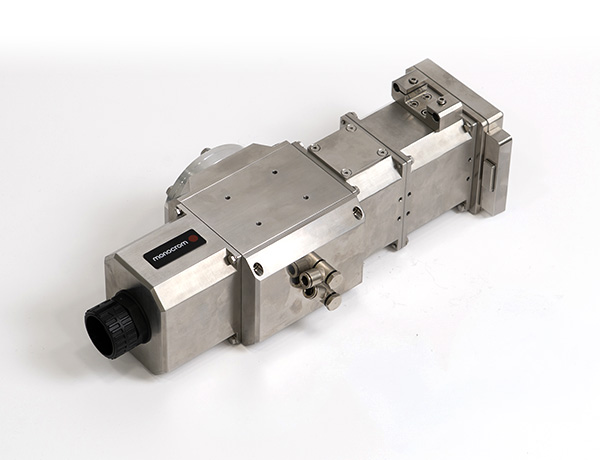
We design and manufacture multi-kilowatt direct diode sources specifically for conduction welding and cladding, with a compact high-irradiance spot. We supply them with their power and control electronics, including closed-loop temperature control with a pyrometer, which keeps the melt pool stable even when the part geometry or heat dissipation changes.
References 1. Barnes S, Timms N, Bryden B, Pashby I. High power diode laser cladding. J Mater Process Technol. 2003;138(1–3):411–416. doi:10.1016/S0924-0136(03)00109-2 2. Pflueger S. Laser cladding with direct diode lasers. Industrial Laser Solutions (Laser Focus World), 1 de junio de 2009. 3. AMADA WELD TECH. Laser Welding Fundamentals. White paper, 2016. 4. Walsh CA, Bhadeshia HKDH, Lau A, Matthias B, Oesterlein R, Drechsel J. Characteristics of high-power diode-laser welds for industrial assembly. J Laser Appl. 2003;15(2):68. 5. Farahmand P, Kovacevic R. Parametric study and multi-criteria optimization in laser cladding by a high power direct diode laser. Lasers Manuf Mater Process. 2014;1(1):1–20. doi:10.1007/s40516-014-0001-0
Have a welding or cladding process?
Tell us about the material, the thickness or layer you need and the production rate, and we will work with you to define the most suitable source. We develop custom solutions for equipment manufacturers and integrators.