Diode sources for laser transmission welding of polymers
Laser transmission welding joins two thermoplastic parts without contact, vibration or particles. The beam passes through the upper part, which is transparent at the laser wavelength, and is absorbed at the surface of the lower part, which contains an absorber such as carbon black or a pigment. The interface melts, heat is conducted into the upper part and, under clamping pressure, both parts fuse into a clean, sealed seam without affecting the outer surfaces. In many applications this technique has progressively replaced friction, vibration and ultrasonic welding [1].
Near-infrared transmission welding
Near-infrared diode lasers (800–1100 nm) are among the most widely used sources, because most unfilled thermoplastics are highly transparent in this region [1, 2]. The process is controlled through power, speed and beam size, and supports several strategies [1]:
Strategy
Description
Suitable source format
Contour
A spot travels along the weld line
Fiber-coupled diodes
Quasi-simultaneous
A scanner traces the contour many times per second so the whole seam melts at once
Fiber-coupled diodes
Simultaneous
The whole seam is irradiated at once with a diode line or pattern
Line or area emission modules
Mask
A mask defines the pattern irradiated by a line sweeping across the part
Line emission modules
In tests carried out with the Laser Centre of the Universidad Politécnica de Madrid (UPM), we have validated our 940 nm sources in transmission welding of PMMA and PVC, using both a 1 kW fiber-coupled diode module and a line emission module of ~250 mm [3]:
Joint
Source
Parameters
Result
Transparent PMMA 2 mm / white PMMA 3 mm
Fiber-coupled
60 W, focused beam, 200 mm/min
Strong joint; affected zone ~1.3 mm wide
Transparent PMMA 2–3 mm / grey PVC 2 mm
Fiber-coupled
60 W, defocused beam, 800–1000 mm/min
Withstands a 1.5 m drop and a wedge opening test
White PMMA 3 mm, fillet weld
Fiber-coupled
292 W, focused beam, 200 mm/min
Both parts fused at the joint
Transparent PMMA / white PMMA
Line emission
Static line, 5–20 s
Proof of concept of simultaneous welding of the whole seam
Transmission welding
Thermoplastics
Simultaneous welding
Contactless
Sealed seam
Absorber-free welding at ~2 µm
When both parts must be transparent, or additives are not allowed, as in medical devices, microfluidics or optics, welding can be done at wavelengths around 2 µm. In this region the polymers themselves absorb the radiation, with no absorber required. PE, PP, PMMA, POM and PETG have been welded this way, with polyethylene joints reaching more than 80% of the bulk material strength [4]. Because absorption takes place throughout the thickness, the focusing optics are what concentrate the energy at the interface.
Absorber-free
Transparent polymers
Medical devices
Microfluidics
2 µm
Our sources
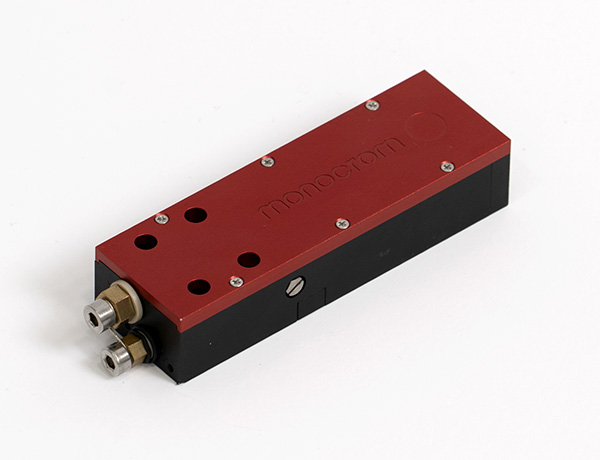
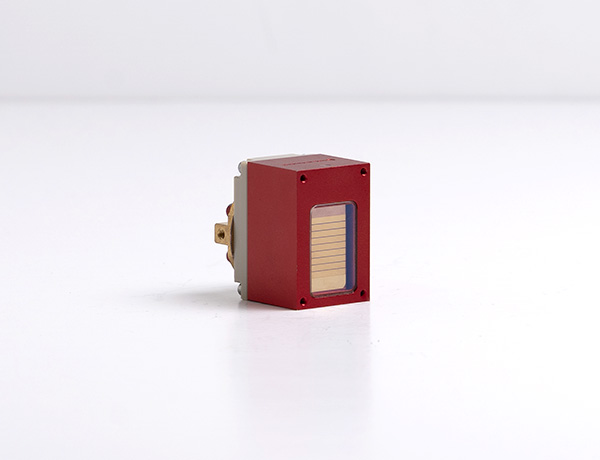
We design and manufacture fiber-coupled diode bars for contour and quasi-simultaneous welding, and line emission modules that irradiate seams hundreds of millimeters long in one go for simultaneous or mask welding. For absorber-free welding we offer fiber-coupled diodes at 2.0, 2.1 and 2.3 µm. We adapt the wavelength, power and beam geometry to the materials and the part.
References 1. Acherjee B. Laser transmission welding of polymers – A review on process fundamentals, material attributes, weldability, and welding techniques. J Manuf Process. 2020;60:227–246. doi:10.1016/j.jmapro.2020.10.017 2. Acherjee B. Laser transmission welding of polymers – A review on welding parameters, quality attributes, process monitoring, and applications. J Manuf Process. 2021;64:421–443. doi:10.1016/j.jmapro.2021.01.022 3. Centro Láser UPM. Pruebas para la validación de sistemas láser desarrollados por Monocrom. Procesos láser industriales. Informe técnico, junio de 2024. 4. Mingareev I, Weirauch F, Olowinsky A, et al. Welding of polymers using a 2 μm thulium fiber laser. Opt Laser Technol. 2012;44(7):2095–2099. doi:10.1016/j.optlastec.2012.03.020
Have a plastic welding challenge?
Tell us about the materials, thicknesses, seam geometry and cycle time, and we will work with you to define the most suitable configuration. We develop custom solutions for equipment manufacturers and integrators.